
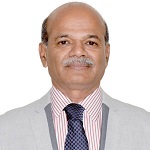
Vasant Shinde
CSIR Bhatnagar Fellow
 040-27192614
 vasant[dot]shinde[at]ccmb[dot]res[dot]in
Research Interests:
Understanding the genesis of the basic sciences and technologies through archaeological sources. The archaeological sources are generated through field investigations such as systematic exploration and excavation. Besides, understanding the process of peopling of South Asia and cultural dispersal through the ages with the help of archaeogenetic records and scientific investigations is the objective of the recent research. Artefacts and ecofacts collected systematically from various archaeological sites are subjected to various scientific analyses such as Strontium, Stable Isotope, Starch Grain, Lipid profile, etc. to understand ancient diet, health and migration.
Selected Publications:
2021. Peopling and Early Cultural Developments in South Asia as Revealed by the First of its Kind Research Based on Archaeogenetic Analyses and Craniofacial Reconstructionof the Human Skeletal Data from Rakhigarhi, Puratattva 50: 34-53.
2019 (et al.). An Ancient Harappan Genome Lacks Ancestry from Steppe Pastoralists or Iranian Farmers, Cell 179, 1-7.
2019. (et. Al.). Craniofacial Reconstruction of the Indus Valley Civilization Individuals found at 4500 years old Rakhigarhi Cemetery, Anatomical Science International, published online on 1st October 2019.
2018 (Shinde et al.). Archaeological and anthropological studies on the Harappan cemetery of Rakhigarhi, India. PLoS ONE 13(2) 1-14.
2014 (with Rick Willis) A New Type of Inscribed Copper Plate from Indus Valley (Harappan) Civilization, Ancient Asia, 5: 1-10.
Education & Experience
P.G.:
Archaeology ; University of Poona ; 1979
Ph.D:
Early Settlements in Central Tapi Basin ; University of Poona ; 1985
Post-doctoral Research:
University of Cambridge and International Research Centre for Japanese Studies ; Kyoto, Japan
No publications found for this person.